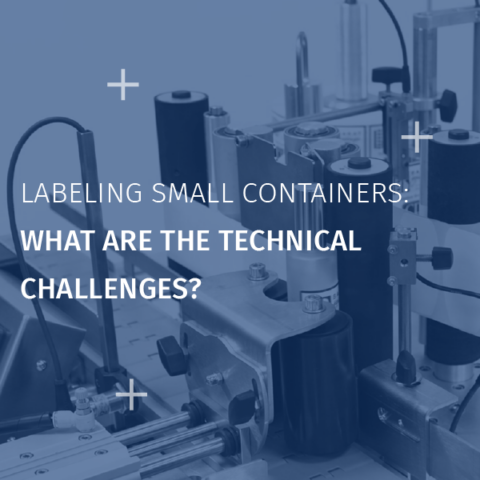
Bottles, vials, small jars, tubes, or small-diameter containers: labeling small formats may seem “simpler.” In reality, it involves several technical challenges. The smaller the available surface area, the more precise the label positioning needs to be. Container stability, diameter, shape, and the type of label used all directly influence the choice of labeling machine…
The challenge is to find a solution that provides consistent labeling while remaining suited to the formats actually being used. So, what are the main challenges involved in labeling small containers, and how do you choose the right packaging solution?
Why Are Small Containers More Difficult to Label?
A small container naturally provides less surface area for labeling. A variation of just a few millimeters is much more noticeable than on a large bottle. The challenge is therefore not only related to label size. It depends on the combination of the following factors: the container, the label, and the labeling machine.
Several parameters related to the container and labels need to be considered:
- diameter;
- height;
- shape;
- stability during application;
- label size and shape;
- number of labels to apply;
- production volume.
These factors determine which options are required to achieve precise labeling.
Container Diameter: A Key Factor
For small cylindrical formats, diameter is one of the first factors to consider. A small-diameter container provides limited surface area and requires controlled label application around its circumference.
If the container is too small for a machine’s configuration, the label may be difficult to position correctly or apply consistently. This is why we always assess container dimensions before defining a labeling solution.
Our range of labeling machines includes several machines designed for different formats, including small products with reduced diameters.
For small cylindrical products, our Ninette Auto Mini is particularly well suited. It can be used for a variety of applications, including in the cosmetics, food and beverage, pharmaceutical, and chemical industries.
This automatic labeling machine is an interesting solution for:
- small production runs;
- frequent product changeovers;
- companies looking to progressively automate their production;
- small products that are difficult to label manually with consistent results.
An automatic labeling machine can also be integrated after filling and capping operations, making it possible to create a fully automated packaging line.
Our Ninon 1500 is also part of our automatic labeling solutions and can be integrated into a variety of packaging projects. It can be particularly well suited to small containers once various adaptations have been implemented by our engineering department.
Container Stability During Labeling
Another key consideration is container stability. When a bottle is very small or lightweight, it can be more difficult to keep it properly positioned during label application. To achieve consistent results, the container must remain correctly positioned while the label is applied.
This issue is particularly important for small-diameter cylindrical containers, but it can also affect small bottles with unusual shapes. The holding system and application method must therefore be studied according to the actual container.
To help you assess this aspect, our Research & Development team works closely with our sales team and engineering department to develop a suitable and long-lasting solution.
One or Multiple Labels: An Important Difference
Labeling a small container can also become more complex when several labels need to be applied. A main label, back label, tamper-evident label, or even a specially shaped label may require different machine configurations.
On a small container, the available space must be carefully assessed to prevent labels from overlapping or creating areas that are difficult to reach.
It is therefore important to define the following from the outset:
- the number of labels;
- their dimensions;
- their position;
- their application direction;
- the available space on the container, i.e., the flat surface that will be used as a reference.
This information helps determine whether a single labeling station is sufficient or whether a more complete configuration is required.
How Do You Choose a Labeling Machine for Small Containers?
Before selecting a machine, our experts need to gather several pieces of information, including:
- Container format. The diameter, height, and, when necessary, the different areas of its geometry must be measured precisely.
- Label type. The dimensions, material, shape, and number of labels to be applied must be determined.
- Desired label positioning. A centered label, a wraparound label, or a label applied to a specific location may not require the same machine configuration.
- Production volume. A few hundred containers per week will not necessarily require the same equipment as an industrial-scale production line.
- Products and formats to be handled. The greater the number of formats, the more important quick and easy changeovers may become.
What If Labeling Is Part of a Complete Packaging Line?
On a complete packaging line, labeling should not be considered as an isolated operation. The container must arrive correctly positioned from the previous station, be labeled, and then continue through the line without disrupting the following operations.
At CDA, a complete packaging line can combine filling, capping or screwing, and labeling. We can therefore integrate our labeling solutions into larger projects, upstream or downstream of some of your existing equipment, thanks to our expertise as an industrial systems integrator. This approach allows the entire production flow to be taken into account rather than selecting each piece of equipment independently.
Labeling small containers requires particular attention because every millimeter can matter. Small diameters, limited surface area, container stability, label dimensions, desired positioning, and production speed are all factors that need to be considered.
Are you labeling small containers and want to determine which solution would be suitable? Contact us today! Share your packaging project with us, regardless of your industry, and we can assess your requirements and determine the most suitable labeling solution.
FAQ: Labeling Small Containers
Why is packaging a small container, especially labeling it, more difficult?
A small container provides limited surface area and leaves less room for label positioning. Its diameter, stability, and geometry therefore need to be carefully considered.
Which semi-automatic or automatic labeling machine should I choose for a small cylindrical bottle?
The choice depends on several factors, including the bottle’s diameter, dimensions, label, and production volume. For certain small cylindrical products, solutions such as the Ninette Auto Mini or Solo can be considered.
Can very small containers be labeled automatically?
Yes, certain machines are designed for small formats. However, compatibility must be checked based on the exact dimensions of the container and label. Our teams can also organize testing under real-world conditions in CDA’s facilities.
Can multiple labels be applied to a small container?
Yes, depending on the product configuration and the machine. However, the available space and the positioning of each label must be taken into account. Multiple labeling stations may be required on your packaging machine.
Is a semi-automatic labeling machine suitable for small production runs?
It can be particularly relevant when production volumes remain moderate or when a company wants to progressively automate its labeling process while maintaining a certain level of flexibility.
Can labeling small containers be integrated into a complete packaging line?
Yes. Depending on the container and the other operations required, a labeling machine can be integrated into a complete packaging line combining, for example, filling, capping or screwing, and labeling.