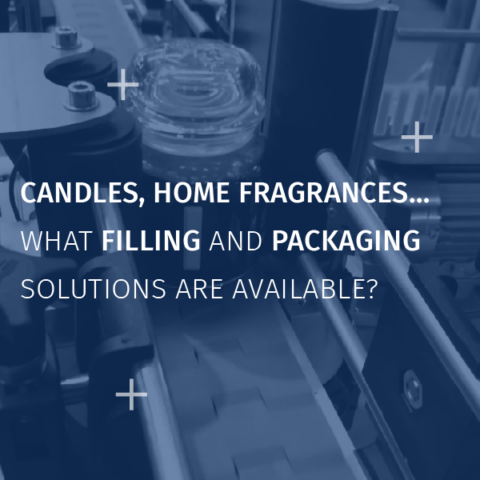
Scented candles, home fragrance diffusers, room sprays: these products have one thing in common. Their packaging requirements vary considerably depending on their composition, container, and intended market.
Whether you’re a small business developing your first product line or a company looking to increase production volumes, choosing the right equipment raises several questions: How do you fill liquid or viscous products? How do you close a bottle fitted with a screw cap or a dispensing system? How do you apply labels to jars, bottles, or candles? And when should you consider automation?
At CDA, we design filling, capping, screw-capping, and labeling solutions, as well as monobloc machines and complete packaging lines. The right equipment depends first and foremost on the product being packaged and your production goals.
1. Different Packaging Requirements Depending on the Product
Filling Home Fragrances and Diffusers
Home fragrances come in several forms: room sprays, perfume bottles, reed diffusers, and refill bottles. A low-viscosity liquid intended for a small bottle has different requirements from a more viscous product or a formulation that requires a specific dosing method. Filling accuracy, dose repeatability, and ease of format changeover are therefore important factors to consider from the outset.
For these applications, we assess your requirements to help identify the most suitable filling machine for your product.
The closure system requires the same level of attention. Screw caps, pumps, spray nozzles, or other dispensing systems: each configuration must be evaluated to determine whether mechanical capping or screw-capping is possible and which equipment would be appropriate.
2. Labeling Scented and Decorative Candles
For candle manufacturers, labeling is an important step in preparing products for sale. Containers can include glass jars, metal containers, and other types of packaging, each with different dimensions and shapes.
We offer semi-automatic labeling solutions, including labeling machines designed for scented and decorative candles.
For small-scale artisan production, a semi-automatic machine can improve labeling consistency while allowing the operator to remain involved in the process.
Our experts may recommend, for example, the Ninette 1 or the Ninette Auto. Ideal for small to medium-sized production runs, these packaging machines help speed up labeling and increase production rates for cylindrical products.
As production volumes increase, it becomes worthwhile to consider a solution that can handle more containers while reducing manual handling. At this stage, automating your packaging process becomes essential.
In this case, automatic labeling machines may be the right choice, such as the Ninon 1500/2500, which can label up to 25 products per minute, or the Ninon Konic, which is particularly well suited to the more varied container shapes found in the candle and home fragrance industries. The latter can reach speeds of up to 40 products per minute, offering a significant advantage for your packaging operations.
3. Monobloc Machines or Complete Packaging Lines: Which Setup Should You Choose?
A Monobloc Machine to Combine Multiple Operations
When several consecutive operations need to be automated within a limited space, a monobloc machine can be an effective solution.
Our packaging monobloc machines combine filling, screw-capping, and labeling operations. The right configuration depends on the product, container, closure, and functions required.
For small containers, such as small room spray bottles, smaller candles, or compact diffusers, the E-Fill and E-Fill SW monobloc machines are suitable options. For more specific applications, particularly products fitted with dropper caps, our R&D team has developed the E-Fill SW Dropper.
A Complete Packaging Line to Coordinate Operations
For higher production volumes or product ranges requiring several consecutive operations, a complete packaging line makes it possible to organize filling, capping, and labeling within a single process.
CDA complete packaging lines are designed around each project’s specific requirements. Equipment, conveyors, dimensions, and technologies are selected according to the products and containers being handled.
Conclusion: Choosing the Right Packaging Solution for Each Product
Scented candles and home fragrances share packaging challenges related to presentation, consistency, and production organization, but their technical requirements remain different.
For candle manufacturers, labeling may be the first step toward automation. For home fragrances, a packaging project may also include filling, screw-capping or capping, and eventually evolve into a monobloc machine or a complete packaging line.
At CDA, we assess each project based on the product, container, operations required, and production goals. This approach helps identify a solution that genuinely meets your needs rather than selecting equipment based solely on its theoretical production speed.
Have a Packaging Project in Mind?
Are you looking to fill home fragrances, automate candle labeling, or set up a packaging line for your household products? Contact our team to discuss your product, containers, and production goals.
FAQ: Packaging for Candles, Home Fragrances, and Household Products
Which machine should I choose to label scented candles?
The right choice depends on the shape and dimensions of the container, the number of labels to apply, and production volume. A semi-automatic labeling machine can be particularly suitable for manufacturers looking to improve labeling consistency while keeping an operator involved in the process.
Can home fragrance packaging be automated?
Yes, depending on the product, container, and operations required. A project may involve filling, capping, and labeling, using standalone machines, a monobloc machine, or a complete packaging line. The compatibility of each operation must be assessed.
Can filling and labeling be performed on the same machine?
Yes. Some monobloc machines combine several operations, including filling, screw-capping, and labeling, depending on their configuration. It is important to check that the product, container, and closure are compatible with the required functions.
Do all packaging operations need to be automated?
No. You can start by automating a single operation, such as labeling or filling, and then expand your setup as production volumes and requirements evolve. The level of automation should address an actual production need.
How should I prepare a packaging project?
We recommend gathering information about your product, the containers and closures you use, your labels, production volumes, and target production speeds. Representative samples can also help assess feasibility and validate the proposed solution.