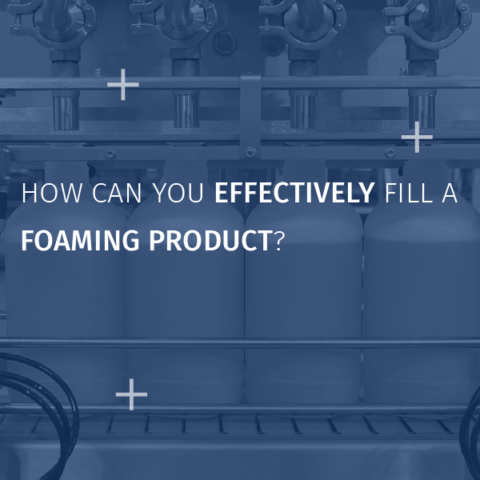
Filling a foaming product may seem simple: all you have to do is introduce the desired amount into the container. In practice, foam formation can quickly make the process more difficult. The product may rise, overflow, create the appearance of an incorrect fill level, or make accurate dosing more difficult to control.
This issue affects many types of products, including detergents, liquid soaps, certain cosmetic products, cleaning products, and some food formulations.
To achieve consistent and controlled filling, it is therefore important to consider the actual behavior of the product and adapt the dosing technology, filling parameters, and various components such as the filling nozzles.
Why Do Some Products Foam During Filling?
Not all products behave the same way. Two liquids with similar viscosities can react very differently when it comes to foam formation. The product formulation therefore plays an important role, but the way the product is transferred into the container can also increase or reduce the phenomenon.
This is why knowing the general nature of a product is not enough to select a filling machine. Its behavior must be observed under actual dosing conditions.
Filling Speed
Filling speed can affect how the product behaves. Filling too quickly can create turbulence and introduce air, depending on the characteristics of the formulation. However, simply slowing down the machine is not always the best solution.
The goal is to find the right balance between filling speed and product behavior in order to achieve consistent dosing while maintaining a production rate that meets the company’s objectives.
Choosing the Right Filling Nozzle
The filling nozzle is the interface between the filling system and the container. Its design and use must be adapted to the product being filled.
We have also dedicated an article to different filling nozzles for different types of products, as product characteristics directly influence the choice of this component.
For foaming products, controlling the flow and the way the product enters the container are particularly important. Depending on the application, different configurations can be considered to reduce turbulence and promote more consistent filling.
Filling with a Diving Nozzle
A diving nozzle can reduce the distance the product falls and may therefore help reduce foam formation. The principle consists of bringing the point where the product enters the container closer to the bottom, then adapting the nozzle movement as the container fills. This solution can be particularly useful when the product foams easily and the container configuration is suitable for it.
However, the appropriate system must be determined on a case-by-case basis. A diving nozzle is not automatically required.
Filling Machines for Foaming Products
There is no universal filling machine for all foaming products.
For small or medium-sized production runs, a semi-automatic filling machine may be an appropriate solution. For larger production volumes, filling can be integrated into an automated production line.
Our K-Net is a semi-automatic filling machine designed for different types of products, including liquid, viscous, and pasty products. It can also be configured with different dosing systems depending on the nature of the product.
Our K-Line S is an automatic filling machine that can be equipped with diving nozzles. Numerous options can be added to precisely match a wide range of filling requirements. This filling machine can also be integrated into a complete production line.
Why Are Product Trials Particularly Important for Foaming Products?
A foaming product can behave differently depending on the filling speed, dosing system, container, and nozzle configuration.
This is why a trial using the actual product and container can provide particularly useful information. During a trial, several factors can be observed:
- foam formation;
- how quickly the foam appears;
- how it develops during filling;
- how the product behaves as it approaches the final fill level;
- any splashing;
- dosing consistency;
- the impact of different settings.
These observations can then be used to determine a configuration that is consistent with the project’s objectives.
Does your product foam during filling? Contact us to discuss its characteristics, your containers, and your production goals. We can work with you to determine the dosing technology and configuration best suited to your project.
FAQ: Filling Foaming Products
How can you prevent a product from foaming during filling?
The dosing technology and filling parameters must be adapted to the characteristics of the product. Depending on the application, the choice of nozzle, filling speed, or an appropriate filling system can help reduce foam formation.
Can foaming products be filled automatically?
Yes. Some filling machines can handle foaming products. However, the configuration must be adapted to the product, container, and filling requirements.
Can the K-One fill a foaming product?
Yes, the K-One can dose low-foaming products. Appropriate settings can help limit foam formation during filling.
Is the K-Line S suitable for foaming products?
Yes. The K-Line S is designed for liquid, foaming, or thick products. It can also be equipped with a diving nozzle as an option.
Should a machine be slowed down when filling a foaming product?
Not necessarily. Reducing the filling speed can help limit foam formation, but it is preferable to evaluate the entire filling system in order to find the right settings for the product and the desired production rate.
Why conduct a filling trial?
A trial makes it possible to observe the actual behavior of the product with the machine, filling nozzle, and container intended for the project. It helps determine the most appropriate settings and configuration.
Are cleaning products particularly prone to foaming?
Some cleaning products, such as cleaners, can indeed be foaming products. However, their behavior depends on their formulation.