In a packaging line, the quality of the finished product does not depend solely on dosing accuracy, consistent capping, or label placement. It can start earlier, as soon as the container is prepared. Whether bottles, vials, or jars, containers can accumulate dust, micro-debris, or residue during manufacturing, storage, or transportation.
Integrating a bottle blower helps secure the upstream filling stage by improving container hygiene. In certain industries, such as food and beverage or pharmaceuticals, this operation can even become a genuine performance driver.
But how should a bottle blower be integrated into an existing packaging line or a new packaging project? Where should it be positioned? Which machines should it be combined with?
Why integrate a bottle blower into a packaging line?
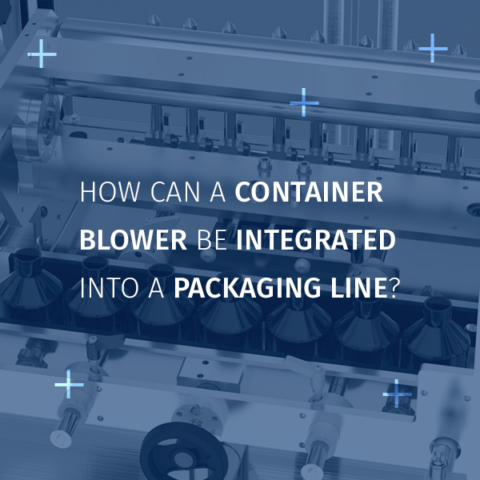
A bottle blower is designed to clean the inside of containers. The principle is simple: the container is picked up, inverted, and positioned in front of a nozzle through which a stream of compressed air removes dust and particles. This operation takes place upstream of filling and does not slow down the line when the integration has been properly designed. The benefits of such a machine are numerous:
- Preserve finished product quality;
- Improve the hygiene of the packaging line;
- Reduce the risk of returns, non-conformities, or customer complaints;
- Improve packaging line reliability by adding an upstream cleaning and control step.
At CDA, this approach is part of a comprehensive vision of packaging: every machine should contribute to overall performance, from the arrival of the container to the finished product. The Win-Dy bottle blower was specifically designed to integrate upstream of other CDA equipment, including fillers, capping machines, capper units, labelers, and monobloc machines. The Win-Dy automatically inverts containers and performs internal air blowing before filling.
Where should the bottle blower be positioned in the line?
In most cases, the bottle blower is positioned between the container infeed and the filler. The typical sequence is as follows:
- Infeed table or line entry system
Bottles, vials, or jars are regularly fed onto the conveyor. - Bottle blower
The blower handles the containers, inverts them if necessary, and removes particles from the inside. - Automatic or semi-automatic filler
Once the containers are clean, they move to the dosing/filling machine suited to the viscosity of the product. - Capping or capper machine
Caps, closures, pumps, or droppers are placed and tightened according to the selected technology. - Labeler
The closed product is then finished with one or more labels, according to the specifications.
This positioning helps minimize the time between cleaning the container and introducing the product. It is particularly relevant when packaging is stored in the production area, handled at several workstations, or exposed to a dusty environment.
What criteria should be analyzed before integrating a bottle blower?
Integrating a bottle blower is not simply a matter of “adding a machine” to a conveyor. For it to provide real value to the packaging line, several parameters must be considered.
The type of container being processed
The first criterion is, naturally, the container itself:
- rigidity (glass or plastic);
- neck diameter;
- height, weight, and stability;
- specific geometry.
These characteristics will influence the gripping, inverting, and blowing systems. A line handling small 10 mL vials will have different requirements from a line designed for wider jars or taller bottles.
The CDA Win-Dy was designed to accommodate different container formats and materials, making it an interesting solution for multi-format lines.
Production speed
A bottle blower must be consistent with the overall line speed. Installing a blowing system that becomes a bottleneck for the entire line would be counterproductive. It is therefore important to consider the overall line speed:
- How many containers per hour need to be processed?
- Is the speed stable or does it vary depending on the format?
- Does one container need to be blown at a time, or several simultaneously?
- Does the line need to handle production peaks?
The Win-Dy can reach speeds of up to 1,200 containers/hour (for certain jar formats, and higher speeds with lighter containers), allowing it to be integrated into many different configurations.
The nature of the product being packaged
The more sensitive the product, the more critical container cleanliness becomes. This is particularly true in the food and beverage industry. Integrating a bottle blower before the filler is not simply a matter of operational convenience: it is a way to improve process security.
The configuration of the existing line
For an existing line, the following elements should be checked:
- available space;
- working height;
- direction of container flow;
- mechanical and electrical interfaces;
- accessibility for cleaning and maintenance;
- synchronization with other machines.
Successful integration requires an overall approach: the bottle blower must be compatible with the conveying system, the speeds of the filler, capper, and labeler, as well as transfer times between workstations.
The filler: the heart of the dosing process
After blowing, the clean container is directed to the filler. This machine must be selected according to:
- product viscosity;
- required dosing accuracy;
- filling volume;
- target production speed;
- desired level of automation.
In a well-designed line, the bottle blower feeds the filler at a consistent rate, without sudden stops or excessive accumulation. The conveyor, stops, sensors, transfers, and other components must therefore be designed to work together.
At CDA, our filling solutions cover a wide range of requirements, in both automatic and semi-automatic configurations, for liquid, fluid, viscous, and more complex products to dose. For example, the K-Line S can be integrated downstream of the Win-Dy.
The capper: ensuring reliable container closure
Once the product has been dosed, the container must be closed with the required speed and repeatability. Depending on the application, this may involve:
- a screw cap;
- a closure;
- a pump;
- a dropper cap;
- a tamper-evident or security system.
Here again, consistency between workstations is essential. For example, downstream of a Win-Dy and a K-Line S, we can integrate a VS 2000.
The labeler: the final product-enhancement step
After cleaning, filling, and closing, labeling completes the product. This step is not simply about aesthetics: labels also provide essential information related to traceability, use, compliance, and branding.
A properly sized line must prevent the labeler from becoming overloaded by upstream equipment. CDA offers a range of labeling machines that can be integrated into complete lines, with configurations adapted to cylindrical, flat, and conical containers, such as the Ninon Mix.
The tangible benefits of a bottle blower
When properly integrated, a bottle blower does more than simply “blow air” into a container. It contributes to the overall efficiency of the packaging line.
1. Better quality control
The first benefit is obvious: the container arrives clean at the filler. This helps reduce the risk of foreign matter entering the product and improves consistent quality.
2. Improved hygiene throughout the line
In industries where hygiene is an important commercial or regulatory requirement, blowing out containers is a logical step in the process.
3. Fewer incidents
A cleanliness issue detected after filling or labeling will always be more costly to address. By positioning the bottle blower upstream, the issue is addressed at the right time: before value is added through the product, capping, and labeling stages.
4. Compatibility with a complete packaging line
The Win-Dy was designed as a complementary solution to CDA packaging equipment. It can therefore be integrated into a comprehensive complete-line approach combining filling, capping, and labeling.
A bottle blower: an investment in performance
Long considered a complementary piece of equipment, the bottle blower nevertheless has an important role to play in packaging projects. The reason is simple:
Integrating a bottle blower upstream of the filling process helps improve container preparation and strengthen the consistency of the entire line. It naturally works alongside a filler, capper, and labeler.
At CDA, this continuity between blowing, filling, capping, and labeling operations is part of our comprehensive approach to packaging. The Win-Dy therefore complements an ecosystem of machines designed to meet a wide range of requirements.
Would you like to learn more about our packaging solutions? Contact our experts today!
FAQ : How do you integrate a bottle blower into a packaging line?
What is the purpose of a bottle blower in a packaging line?
A bottle blower cleans the inside of bottles, vials, or jars before filling. It helps remove dust, micro-debris, and particles that may accumulate during packaging storage, transportation, or handling.
Where should a bottle blower be positioned on a packaging line?
The bottle blower is positioned between the container infeed and the filling machine. This configuration allows the container to be cleaned immediately before dosing.
Why combine a bottle blower with a filler, capper, and labeler?
Because an efficient packaging line relies on continuity between each workstation. The bottle blower prepares the container, the filler doses the product, the capper closes the container, and the labeler completes the product’s presentation and identification.
Which industries can benefit from integrating a bottle blower?
Industries such as food and beverage, nutraceuticals, and premium product manufacturers can benefit from integrating a bottle blower when container cleanliness is an important quality, safety, or brand-image consideration.
How do you choose a bottle blower?
The choice depends on the type of container, production speed, desired level of automation, available space on the line, and compatibility with the other packaging equipment.