When choosing a packaging machine, comparing technical specifications or production speeds is not enough. A filling machine, capping machine, or labeling machine must first and foremost be suited to the product, container, and desired results. This is why product testing is an important step in validating a packaging project. Testing allows different technologies and machines to be evaluated with the actual product to determine whether the proposed solution truly meets the project’s requirements.
For our experts, these tests give you more concrete information to make an informed decision. While testing is not mandatory, we strongly recommend it: it helps ensure that the selected solution fully meets your expectations.
Testing Your Product Before Buying a Machine
Two liquids that look similar can behave very differently. One product may foam, while another may not. A paste may behave differently depending on its temperature or formulation. Conductivity can also vary from one product to another. These characteristics can have a direct impact on the packaging process.
A product test therefore helps answer the following question: Can the proposed technology or machine achieve the required performance, particularly in terms of speed and accuracy?
What Can a Filling Test Actually Determine?
Our filling machines are designed for a wide variety of products and applications. A technical data sheet cannot always answer every question that a test can address by observing the product’s actual behavior.
Checking the Dosing Technology
The first objective is to determine which dosing system is best suited to the product. Different technologies may be considered depending on the application. For example, our K-One filling machine uses a peristaltic pump. The K-Net, on the other hand, can be equipped with an electromagnetic flowmeter, mass flowmeter, or piston dosing system.
Testing makes it possible to evaluate the product’s behavior and the quality of the filling obtained with each technology. This also has an impact on the machine’s price: some dosing systems are more expensive than others. The customer can then choose the solution that best fits their budget and requirements in terms of accuracy, production speed, repeatability, and other criteria.
Identifying Potential Challenges
A test can reveal issues that were not identified during the initial assessment: product behavior, foam formation, flow characteristics, residual dripping, or the need to adjust certain parameters.
This is precisely where testing adds value. Potential challenges can be identified before the machine is purchased and installed. Our teams can then use their technical expertise to fine-tune the project and ensure that the final solution meets the requirements that have been defined.
Testing Labeling
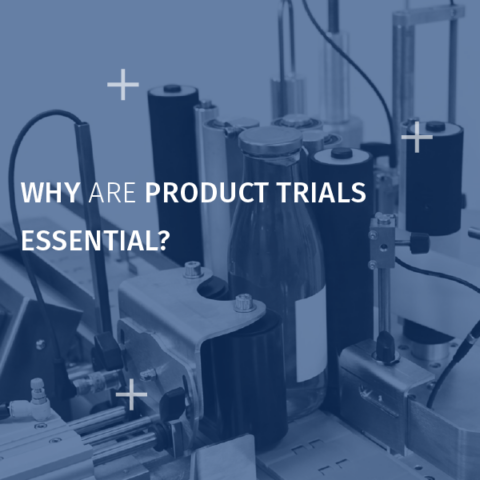
The label must be compatible with the container. Cylindrical, square, rectangular, or unusually shaped containers do not behave in the same way when a label is applied. Testing makes it possible to check the desired label positioning as well as the achievable production speed.
Our range of labeling machines covers a wide variety of container configurations. Whether you are considering the Ninon Konic, Ninon Side, or Ninon Down, analyzing the product and packaging remains essential to determining the most appropriate solution.
Why Should You Provide Your Actual Products for Testing?
To obtain representative results, our teams conduct tests using your actual products. A substitute product may behave differently in terms of viscosity, flow, adhesion, and other characteristics. This can lead to inaccurate conclusions. Whenever possible, it is therefore preferable to provide the actual products that will be packaged.
A change in suppliers, and therefore in the quality or characteristics of the cap, container, or label, can also affect the quality of the final packaging process. This is not always the case, but it is a possibility that our experience has demonstrated. The closer the tested components are to those that will be used in actual production, the more relevant and reliable the test results will be.
Can Product Testing Help Determine the Right Production Speed?
Testing helps provide a better understanding of actual production conditions. The goal is not simply to reach the machine’s maximum possible speed. An efficient packaging process must also take into account filling consistency, format changes, container feeding, capping quality, setup and adjustment times, and other factors.
A machine’s published production speed does not necessarily mean that the same speed will be achieved under identical conditions with every product and container. For example, a filling machine can process more liters per hour when filling 2-liter containers than when filling 100 ml containers. The same applies to labeling: small products with small labels can generally be processed at a higher rate than larger containers requiring larger labels.
Testing therefore makes it possible to put machine performance into the context of the actual project.
Before investing in a packaging machine, testing your product helps reduce uncertainty and provides concrete information on which to base your decision. Testing can verify the dosing principle, observe how the product behaves, evaluate the container, and identify potential adjustments before production begins.
This approach is relevant to all types of packaging projects. Validating compatibility between the product and the future equipment helps eliminate uncertainty and increase confidence in the selected solution.
At CDA, we consider testing an important part of the packaging project assessment process. It allows us to better understand the product, determine the appropriate technology, and develop a solution that is consistent with the customer’s actual requirements and constraints. In many cases, testing is one of the best ways to ensure customer satisfaction.
Do you have a product to package and are unsure which machine or technology to choose? Contact us to discuss your product, containers, and production goals. Depending on your project, we can work with you to determine the most suitable packaging solution and the tests needed to validate it.
FAQ: Product Testing and Packaging Machines
Why should I test a product before buying a filling machine?
A test makes it possible to verify the proposed dosing technology and identify potential challenges before making an investment.
What products should be provided for a test?
Ideally, you should provide the actual product that will be packaged, preferably from the same manufacturer and with the same formulation. The final containers, caps, and labels should also be provided whenever possible to obtain representative results.
Can multiple dosing technologies be tested?
Depending on the project, several technologies can be evaluated or tested to determine which one best matches the product’s characteristics, production objectives, and planned investment. Some technologies are significantly more expensive than others, but a more expensive solution is not necessarily justified if the required level of accuracy or production speed does not call for it.
Can a test determine the actual production speed of a machine?
A test conducted under real or representative conditions helps provide a more accurate picture of the production speed that can be achieved once the machine is installed and configured for the application.
Can capping and labeling also be tested?
Yes. When required by the project, capping and labeling can also be tested and validated using the final containers and components.
Is it useful to conduct another test if a product changes?
Yes, if a change in formulation, container, or cap could affect the machine’s operation. A new test can verify compatibility with the updated configuration.
Are product tests only useful for large companies?
No. Testing can be particularly valuable for securing an investment and validating a selected solution, regardless of the company’s size.