The dietary supplement market encompasses a wide variety of products, including capsules, tablets, powders, and oils packaged in small bottles. This diversity directly translates into different packaging requirements. A solution suitable for tablets will not necessarily meet the needs of a liquid dietary supplement, and the equipment required will also vary depending on production volumes.
However, dietary supplement packaging is not simply a matter of choosing a counting machine, filling machine, or labeling machine. Hygiene, traceability, batch identification, and consumer information requirements must also be taken into account.
In Europe, dietary supplements are subject to food regulations and specific requirements regarding their composition, presentation, and labeling. Manufacturers and other professionals must also ensure product traceability.
For manufacturers, the challenge is therefore to find the right balance between precision, hygiene, traceability, consistency, flexibility, and level of automation.
Why Is Packaging a Key Issue for Dietary Supplements?
Packaging involves several stages: counting or dosing the product, capping or screwing, and then labeling. Each of these operations has an impact on the consistency of the finished product.
The choice of machinery should therefore not be based solely on production speed. It should also take into account:
- the form of the dietary supplement;
- its physical characteristics;
- the type and format of the container;
- the materials that come into contact with the product;
- cleaning and changeover operations;
- the closure system;
- the type of label to be applied;
- marking and traceability requirements;
- the number of products or SKUs to be packaged;
- current production volumes and future growth.
This comprehensive approach makes it possible to determine which machine is best suited to the application.
Hygiene and Packaging: Why Does Equipment Design Matter?
Regulation (EC) No. 852/2004 requires food business operators to implement appropriate control measures based on the identified risks. Premises, equipment, and materials must be designed and maintained in a way that limits the risk of contamination of food products.
For packaging machines, this means paying particular attention to cleanability, the materials used, and the limitation of unnecessary handling. These considerations are especially important when our R&D team designs our packaging machines. Product or formulation changes must be carried out under appropriate conditions, with the cleaning and inspection procedures required by the process.
Our C-Pills Auto is specifically designed with cleanability in mind, helping to facilitate changeover operations. The machine is designed for the automatic counting of capsules and tablets.
Capsules and Tablets: The Challenge of Accurate Counting
For dietary supplements in capsule or tablet form, the first packaging stage involves counting.
This operation requires consistency: each container must receive the specified number of units. For small production runs, semi-automatic counting with our C-Pills counter can help automate this stage while maintaining a high degree of flexibility.
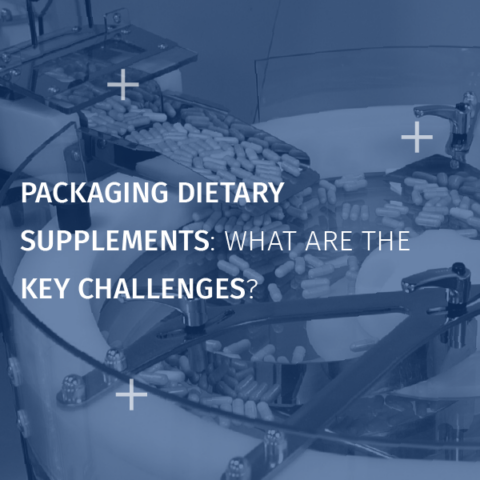
As production volumes increase, an automated solution can be considered. Our C-Pills Auto is an automatic counting machine designed for capsules and coated tablets. It uses a vibrating hopper and a laser curtain counting system. The machine features a stainless steel structure and product-contact parts made from materials suitable for this type of application, including POM-C plastic.
Counting can then be integrated with other packaging operations. We offer a line combining the C-Pills Auto, VS 2000, and Ninon 2500 to carry out counting, capping, and labeling of bottles in succession.
This approach is particularly useful when the goal is to minimize handling between the different stages. This line is designed in particular for the pharmaceutical, food, veterinary, and dietary supplement industries. It can also be equipped with additional solutions such as marking systems and infeed tables.
Liquid Dietary Supplements: Adapting Filling to the Product
Dietary supplements can also be offered in liquid form. There is no one-size-fits-all dosing technology: viscosity, product behavior, filling volume, and container type are all factors that need to be considered when selecting a filling machine.
For a company starting out or producing small batches, a semi-automatic solution such as the K-One can be a suitable first step. Conversely, higher production volumes may require an automatic filling machine such as the K-Line S integrated into a complete line.
Our range of filling machines makes it possible to consider different configurations depending on the products and requirements. The dosing system should be selected based not only on the production process but also on the hygiene and cleaning requirements associated with the product.
Capping and Screwing: Ensuring Continuity Throughout the Packaging Process
After filling or counting comes the container closure stage. Depending on the type of closure, this may involve capping, pressing, or screwing. Our machines are designed to accommodate these different types of closures.
For dietary supplement bottles, screwing can in particular be automated to reduce handling and ensure greater consistency during this stage. Our VS 2000 is an automatic capping machine that feeds caps onto the containers before tightening them.
Labeling: Ensuring Identification, Providing Information, and Supporting Traceability
For dietary supplements, the label plays a particularly important role. It is not only used to display the brand and product information to consumers. Regulations require specific information for dietary supplements, including the recommended daily portion, certain warnings, and information about the nutrients or substances that characterize the product.
The selected equipment must ensure consistent label positioning while being adapted to the container format. For small production runs, for example, we can recommend the Ninette Auto Mini, a semi-automatic labeling machine designed for small cylindrical products.
As production volumes increase, we can offer solutions such as the Ninon 2500 automatic labeling machine, designed for high-volume production and different container formats.
Finally, traceability is a fundamental requirement under food regulations. This is why a packaging line can incorporate marking systems alongside labeling equipment to apply information such as a batch number, date, barcode, or other traceability data.
Monoblock or Complete Line: Which Approach Should You Choose?
The choice between standalone machines, a complete line, and a monoblock system depends primarily on the product and the specific requirements of the project. A monoblock machine combines filling, capping, and labeling operations in a single piece of equipment. For certain liquid products packaged in bottles, this 3-in-1 configuration can be particularly relevant. A complete line, on the other hand, offers greater flexibility in configuring the different stations. It also makes it possible to gradually expand an installation by adding complementary equipment as requirements evolve. Our experts support you throughout each stage of this transition.
The right equipment is not necessarily the equipment that automates the greatest number of operations, but rather the solution that genuinely meets your needs, hygiene requirements, and plans for future development.
Capsules and tablets require an appropriate counting solution. Liquid dietary supplements, meanwhile, require careful consideration of the dosing process. In both cases, capping, screwing, and labeling must then be integrated consistently into the overall process. Packaging must also form part of a broader approach to hygiene and food safety management. Equipment cleanability, reduced handling, changeover management, and batch identification are all factors we take into account when supporting you with your project.
Are you looking for a solution to automate the packaging of your dietary supplements? Tell us about your requirements, and we can work with you to determine the configuration best suited to your project.
FAQ: Dietary Supplement Packaging
What machine should be used to package capsules or tablets?
For capsules and tablets, the packaging process begins with counting. This operation can be carried out using a semi-automatic counting machine such as the C-Pills, or an automatic solution such as the C-Pills Auto.
How can the packaging of a liquid dietary supplement be automated?
The first step is to assess the characteristics of the product, particularly its viscosity and behavior during dosing, as well as the required filling volume. These factors help determine the most suitable filling technology.
Can the capping of dietary supplement bottles be automated?
Yes. Whatever the type of cap, our machines offer efficient packaging solutions. Capping or screwing can be integrated into the process to reduce handling.
Can only part of the dietary supplement packaging process be automated?
Yes. A company can start by automating counting, filling, or labeling, and then expand its installation according to its needs.
Which labeling machine should be chosen for small dietary supplement bottles?
The choice depends in particular on the bottle format, label type, and required production speed. For small production runs, a solution such as the Ninette Auto can be suitable, while for higher production rates, an automatic labeling machine such as the Ninon 2500 can be considered.
Is a complete packaging line only suitable for large companies?
No. The level of automation should primarily match the company’s actual requirements. A complete line can be relevant when several operations need to be automated and coordinated, but a growing company can also choose standalone machines and gradually expand its installation over time.